If your software supports electronic ordering for controlled substances, compliance is not just a feature requirement. It’s part of whether the system can be trusted.
Controlled Substance Ordering Systems, often called CSOS, allow DEA registrants and authorized users to place electronic orders for controlled substances using digital certificates instead of paper DEA Form 222. The DEA states that CSOS is the only method for ordering Schedule I and II controlled substances electronically.
For pharmacies, distributors, manufacturers, and software vendors building or using CSOS-enabled systems, that creates a very specific compliance responsibility.
The software must be able to handle electronic controlled substance orders securely, accurately, and in accordance with DEA requirements.
That is where CSOS software auditing comes in.
A CSOS software audit is not a general pharmacy software review. It is not an end-user certificate enrollment process. It is not a broad operational compliance checklist.
It is a focused independent audit of the software functions covered by DEA regulations.For companies building CSOS-enabled software, the audit helps prove that the application can securely process digitally signed electronic orders and support the compliance expectations tied to controlled substance ordering.
TL;DR: What You Need to Know
- The System: CSOS stands for Controlled Substance Ordering System. It allows eligible DEA registrants to electronically order controlled substances using DEA-issued digital certificates.
- The Software: iBeta’s work is focused on CSOS software auditing for applications that support electronic controlled substance ordering, especially systems used by pharmacies, distributors, and software vendors.
- The Requirement: DEA guidance states that CSOS applications must be audited by an independent third-party auditor before being placed into production and again when regulated portions of the software or cryptographic modules change.
- The Risk: Improperly developed CSOS software or non-approved digital-signing cryptographic modules can create unacceptable risk and the opportunity for diversion of controlled substances.
- The Partner: iBeta has been performing DEA-approved EPCS audits since 2013, bringing more than a decade of relevant controlled-substance software audit experience to the CSOS audit process.
What Is CSOS?
CSOS stands for Controlled Substance Ordering System.
It is the DEA’s electronic ordering system for controlled substances. Instead of relying only on paper DEA Form 222, CSOS allows authorized users to digitally sign controlled substance orders using DEA-issued CSOS Certificates.
According to the DEA, a CSOS Certificate is a digital identity issued by the DEA’s CSOS Certification Authority. It allows for electronic ordering of Schedule I and II controlled substances, as well as Schedule III through V controlled substances, and serves as the digital equivalent of the identification information contained on DEA Form 222.
CSOS Certificates are issued to individuals, not locations, and are used to digitally sign controlled substance orders. DEA guidance also states that only the subscriber whose name appears in the certificate is authorized to use that certificate for a digital signature.
For end users, CSOS can support faster electronic ordering, reduced paper, fewer ordering errors, and electronic validation of DEA credentials. But for software vendors and application developers, CSOS also creates a technical and regulatory responsibility.
If the software enables controlled substance orders to be signed, transmitted, received, or processed electronically, that software has to be built and validated according to DEA expectations.
What Is a CSOS Software Audit?
A CSOS software audit is an independent third-party review of a CSOS-enabled software application.
The purpose is to verify that the application meets the DEA regulatory requirements that apply to electronic controlled substance ordering.
The DEA explains that improperly developed software applications, or digital-signing cryptographic modules that are not federally approved, can create unacceptable levels of risk and may create the opportunity for diversion of controlled substances. For that reason, DEA requires a CSOS application audit by an independent auditor to validate that the software is compliant with DEA regulations described in 21 CFR.
In practical terms, a CSOS software audit helps answer questions like:
- Can the application properly support digitally signed electronic orders?
- Are the required functions built according to DEA expectations?
- Are cryptographic modules handled correctly?
- Does the system protect the integrity of order data?
- Are regulated functions tested and documented?
- Can the company retain audit evidence if DEA requests it later?
This is especially important for software vendors building pharmacy systems, distributor ordering systems, or internal controlled-substance ordering platforms.
Who Needs a CSOS Software Audit?
CSOS software auditing is most relevant to companies that build, sell, maintain, or significantly modify software used for electronic controlled substance ordering.
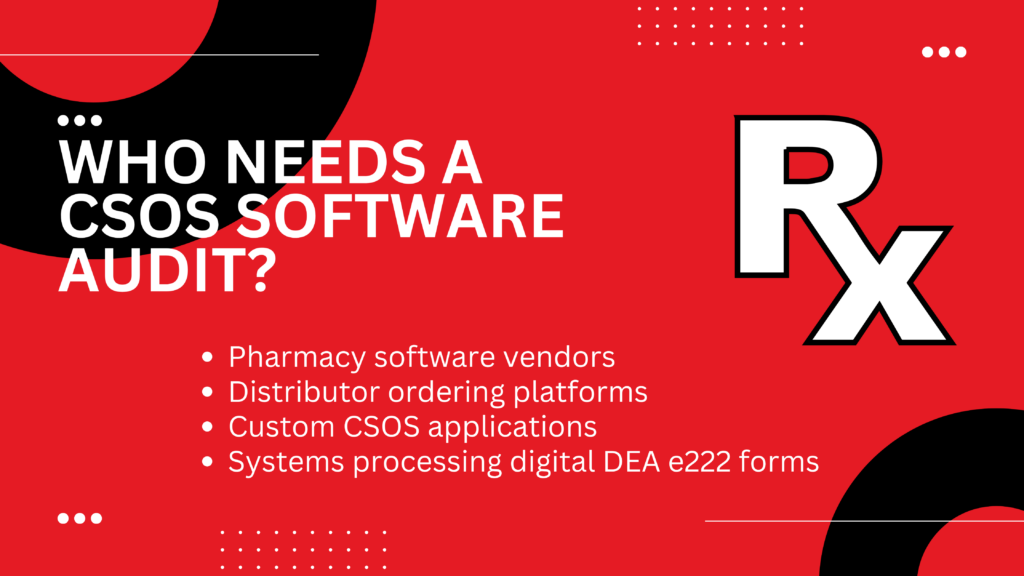
That may include:
- pharmacy software vendors
- distributor software vendors
- manufacturers with controlled substance ordering platforms
- wholesalers using or developing CSOS-enabled systems
- healthcare technology companies supporting electronic controlled substance orders
- companies building custom internal CSOS applications
- organizations modifying a previously audited CSOS application
DEA guidance states that CSOS applications must be audited before being placed into production. It also states that an additional audit is required when changes are made to any portion of the software covered by DEA regulations.
That makes auditing relevant at two important points:
- Before launch or production use
- After regulated software or cryptographic-module changes
For companies purchasing ready-made CSOS software, the DEA states that proof of compliance rests with the company using the application. Purchasers should ensure the vendor has had the application properly audited and should request the auditor’s results as proof. If the application is significantly modified after purchase and installation, it may need to be re-audited.
Why CSOS Software Auditing Matters
CSOS is tied to the controlled substance supply chain.
That makes software quality and compliance especially important.
A defect in an ordinary ordering system can create delays, customer frustration, or operational problems.
A defect in a controlled substance ordering system can create a much larger risk.
The application must help protect against improper ordering, unauthorized signing, data integrity problems, transmission errors, and failures tied to digital certificate use.
CSOS software auditing matters because it helps verify that the software does what the DEA expects it to do.
The goal is not just to pass a review.
The goal is to reduce risk in a system that handles highly regulated transactions.
What Parts of the Application Are Audited?
DEA guidance states that CSOS applications are independently audited to verify that all functions listed in 21 CFR 1311.55(b) and 21 CFR 1311.55(c) are met.
The exact audit scope depends on the application, its architecture, and the functions it performs.
That matters because no two systems are exactly the same.
DEA also states that it does not provide a universal auditing test plan because each system platform is different. Instead, each company or auditing firm drafts its own test plan and scripts specific to the platform and application, using DEA regulations as the basis for the test plan.
For software teams, this means the audit process should begin with scoping.
The auditor needs to understand how the application supports CSOS workflows, which components handle regulated functions, and where digital signing, verification, order processing, data transmission, and error handling occur.
At iBeta, that scoping step is important because it helps focus the audit on the parts of the system that matter for DEA compliance.
When Is a CSOS Application Audit Required?
The DEA states that CSOS applications must be audited before the application is placed into production to ensure the cryptographic modules and software comply with regulations. DEA guidance also states that applications must be audited when changes are made to any portion of the software covered by DEA regulations.
This means CSOS auditing is not only a launch requirement.
It can also become relevant after:
- software updates
- architecture changes
- cryptographic module changes
- changes to digital signing workflows
- changes to verification logic
- changes to regulated CSOS functionality
- significant vendor modifications
- major platform migrations
Not every software change will automatically require a full re-audit. But when regulated functions are affected, those changes must be reviewed to make sure the application still complies.
For software teams, the safest approach is to treat CSOS compliance as part of the product lifecycle.
Do not wait until the end of development to ask whether an audit is needed.
Do CSOS Audit Results Have to Be Submitted to DEA?
No, DEA guidance states that companies are not required to submit audit results to DEA before production.
However, the company is required to maintain the audit results and provide them to a DEA Diversion Investigator upon request. DEA states that its expectation is that a company will retain the audit test plan, results, and auditor’s opinion or attestation letter demonstrating that the system complies with the DEA Rule.
That makes audit documentation very important.
A CSOS audit should not leave a company with vague confirmation.
It should produce evidence the organization can keep, reference, and provide if needed.
For developers, compliance officers, and product leaders, this documentation supports more than launch readiness. It supports accountability.
Why Independent Third-Party Auditing Matters
CSOS applications must be audited by an independent third-party auditor.
DEA guidance states that the auditor should ideally have a background with controlled substance ordering systems and DEA regulations.
Internal development teams know the product deeply. They understand the system architecture, release goals, technical constraints, and customer needs.
But internal teams are not positioned to provide the same objective validation as an independent auditor.
An independent audit helps create a stronger separation between the team that built the system and the team evaluating whether regulated functions comply.
That is especially important when the software is tied to controlled substances, digital signatures, cryptographic modules, and DEA expectations.
How CSOS Relates to EPCS
CSOS and EPCS are not the same thing.
EPCS stands for Electronic Prescribing for Controlled Substances. It relates to electronic prescriptions for controlled substances.
CSOS relates to electronic ordering of controlled substances, often in pharmacy, wholesaler, manufacturer, distributor, or bulk ordering contexts.
The two areas serve different workflows, but they share an important common thread: both involve controlled substances, DEA expectations, regulated software behavior, and independent third-party validation.
That is why iBeta’s long-standing DEA-approved EPCS audit experience matters for CSOS software audit customers.
iBeta has been performing DEA-approved EPCS audits since 2013. That experience gives iBeta a meaningful foundation in controlled-substance software auditing, regulatory interpretation, structured testing, documentation, and working with software teams that need to prove compliance before deployment.
For companies building CSOS-enabled applications, that background is more relevant than a generic testing credential.
You need a partner that understands software quality in a controlled-substance environment.
The iBeta Difference for CSOS Software Audits
A CSOS software audit can feel like one more obstacle between development and launch. But the right audit partner should make the process clearer, not more confusing.
iBeta helps software teams understand the scope of the audit, test the regulated functions, document findings, and move through the process with a clear path.
Controlled-Substance Software Audit Experience
iBeta’s DEA-approved EPCS audit experience dates back to 2013. That gives our team more than a decade of relevant experience in controlled-substance software auditing.
CSOS and EPCS are different programs, but both require careful attention to DEA expectations, secure workflows, documentation, and independent validation.
That background helps iBeta understand the seriousness of CSOS software auditing and the importance of getting it right.
Independent Third-Party Validation
DEA requires CSOS application audits to be performed by an independent third-party auditor. iBeta provides the outside validation needed to help software teams verify regulated CSOS functionality and support compliance documentation.
Independence helps reduce blind spots and gives stakeholders stronger confidence in the audit results.
Clear Scoping
Every CSOS application is different.
Because DEA does not provide one universal audit test plan for every possible system, the audit needs to be scoped around the specific application, platform, and regulated functions.
iBeta works with teams to identify the components and workflows that need review so the audit stays focused and practical.
Transparent Testing and Reporting
A CSOS audit should produce usable documentation.
iBeta provides clear reporting that helps teams understand what was reviewed, what was found, and what evidence supports the compliance position.
That matters because companies must retain audit results and provide them to DEA upon request.
What to Expect From the CSOS Audit Process
While the exact audit process depends on the software, most CSOS audit engagements follow a clear path.
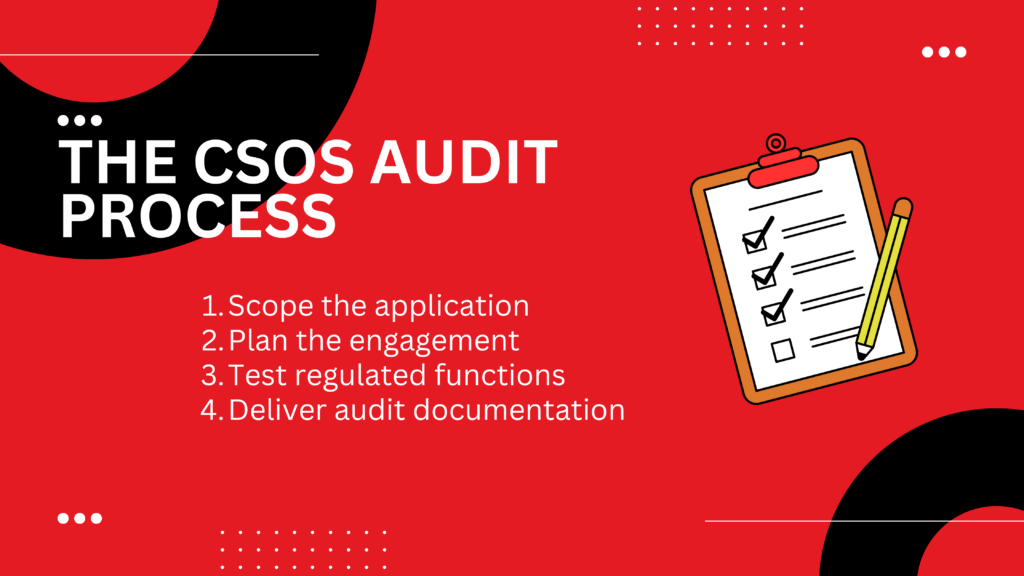
Step 1: Scope the Application
The first step is understanding the system.
Which components interact with electronic controlled substance orders?
Where does digital signing happen?
Where are certificates used?
Where are orders transmitted, received, verified, stored, or processed?
Which parts of the application are covered by DEA regulations?
This scoping process helps define what needs to be tested and documented.
Step 2: Plan the Engagement
The audit should fit into the software team’s development and release timeline.
iBeta works with teams to define the engagement, expected audit activities, timeline, documentation needs, and communication process.
This helps reduce surprises and gives teams a clearer path toward production readiness.
Step 3: Perform the Audit
The audit evaluates the CSOS-related functions that must meet DEA expectations.
Depending on the application, testing may focus on areas such as:
- digital signature workflows
- certificate handling
- regulated electronic order functionality
- cryptographic module requirements
- message integrity
- secure failure behavior
- error handling
- audit evidence
- software changes affecting regulated functionality
The goal is to validate that the CSOS application supports compliant electronic ordering.
Step 4: Deliver Audit Documentation
After testing, teams need more than a verbal summary.
They need documentation they can retain.
DEA guidance states that companies must maintain audit results and provide them to a DEA Diversion Investigator upon request. DEA also expects companies to retain the audit test plan, results, and auditor’s opinion or attestation letter demonstrating compliance.
iBeta’s reporting helps support that documentation need.
Prepare for Your CSOS Software Audit
CSOS software auditing is not just a regulatory step.
It is a way to protect controlled substance ordering workflows, prove regulated functionality, and support trust with customers, regulators, and internal stakeholders.
For software vendors and application developers, the best time to think about CSOS audit readiness is before the application is already under launch pressure.
Ask:
- Does your software process digitally signed electronic controlled substance orders?
- Does it support DEA e222 workflows?
- Are digital signatures and certificates handled correctly?
- Have regulated functions been identified and scoped?
- Has the application been audited before production?
- Have any regulated portions of the software changed since the last audit?
- Do you have audit documentation ready if DEA requests it?
If the answer is unclear, it may be time to discuss your CSOS audit needs with an independent testing partner.
Work With iBeta on CSOS Software Auditing
CSOS software supports one of the most tightly controlled areas of pharmacy and distribution technology.
That means audit readiness matters.
iBeta helps software vendors, pharmacy technology companies, distributors, and controlled-substance software teams navigate CSOS software audits with independent validation, controlled-substance audit experience, clear communication, and documentation that supports compliance.
If your CSOS-enabled software is preparing for production, changing regulated functionality, or needs independent audit support, connect with iBeta to discuss your system and next steps.