Most teams say they are launch-ready when the main features are complete, known bugs feel manageable, and the staging environment looks stable.
That may be enough to feel close to release.
But it is not always enough to prove the software is ready for real users.
Modern software does not fail in a vacuum. It fails when traffic increases, integrations behave unexpectedly, users take paths the team did not predict, or environments vary in ways that were not fully tested. A system may appear ready internally and still break down when exposed to real-world conditions.
That is why “launch-ready” needs a stronger definition. Launch-ready is not just a milestone on a project plan. It is a validated state of readiness, risk, and system behavior.
TL;DR: What Launch-Ready Really Means
Launch-ready software is not just finished code or a stable staging environment. It is software that has been validated for real-world use.
A launch-ready system should have evidence that:
- core functionality works as intended
- performance holds under expected and peak usage
- integrations behave correctly across connected systems
- users can access and use the software across relevant devices and environments
- known risks are documented and understood
- the team is prepared to monitor, support, and respond after launch
In short, launch-ready means the release decision is based on evidence, not assumptions.
What Does “Launch-Ready” Mean in Software?
Launch-ready software is not just functionally complete. It is validated to perform reliably in real-world conditions, with known risks, tested behavior, and operational readiness across systems, users, and environments.
In other words, launch-ready means the team has evidence that the software is prepared for use beyond the controlled conditions of development and staging.
That evidence should answer practical questions such as:
- Does the software do what it is supposed to do?
- Can it perform under expected and peak usage?
- Do integrations behave correctly across systems?
- Are known risks documented and understood?
- Is the team prepared to monitor, support, and respond after launch?
A launch-ready decision should not depend on optimism. It should depend on validation.
What Launch-Ready Is Not
One reason launch readiness is misunderstood is that teams often confuse it with other project milestones.
Launch-ready is not the same as code being complete.
It is not the same as all planned features being built.
It is not the same as passing internal QA.
It is not the same as having no known bugs.
It is also not the same as “it worked in staging.”
Each of those can be important, but none of them prove that software is prepared for real-world use.
Launch-ready is not about the absence of issues. Every release involves some level of risk. The stronger question is whether the team understands that risk, has validated the areas that matter most, and can explain why the release decision is responsible.
A system can have known issues and still be launch-ready if those issues are understood, documented, and determined not to create unacceptable risk.
A system can also appear issue-free and still not be launch-ready if it has not been validated under realistic conditions.
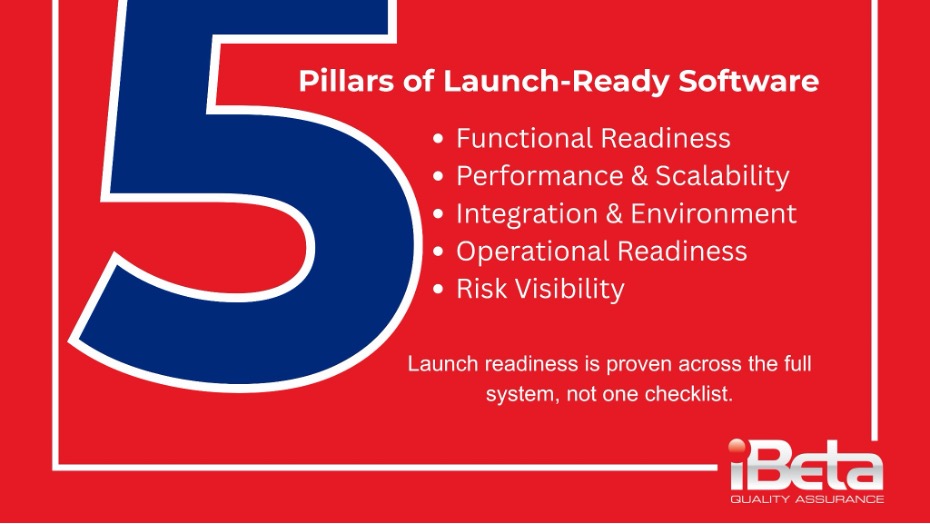
The 5 Pillars of Launch-Ready Software
Modern launch readiness requires more than a simple checklist. It requires evidence across multiple areas of system behavior. Here are five pillars that help define whether software is truly ready to launch.
- Functional Readiness
Functional readiness confirms that the software does what it is intended to do.
This includes validating core features, required workflows, business logic, user paths, and expected outcomes. Functional testing helps ensure that users can complete the actions the software was designed to support.
Examples include:
- account creation
- login and authentication
- form submissions
- search functionality
- transactions
- data entry and retrieval
- user permissions
- core workflow completion
Functional readiness also includes regression testing. As systems change, updates can unintentionally affect existing functionality. Regression testing helps confirm that previous features still work after new code, bug fixes, or configuration changes are introduced.
This is where many teams stop.
They confirm the core functionality works and assume the product is ready. But launch readiness requires more than functional completion.
- Performance and Scalability Readiness
Performance readiness confirms that the software can respond quickly, consistently, and reliably under expected use.
Scalability readiness confirms that the system can handle growth, increased traffic, and heavier demand without a serious decline in quality.
A system can be fully functional and still fail users if it is slow, unstable, or unable to handle traffic at the moment people need it most.
Performance and scalability testing help answer questions such as:
- How does the system behave under expected user load?
- What happens during peak traffic?
- Where do bottlenecks appear?
- How quickly does the system respond?
- Does performance degrade gradually or fail suddenly?
- Can the infrastructure support growth?
Systems do not usually fail at average usage. They fail at pressure points.
That is why performance and scalability testing are essential to launch readiness.
- Integration and Environment Readiness
Most modern software does not operate alone.
Applications connect to APIs, databases, payment processors, authentication systems, third-party platforms, cloud services, analytics tools, and internal systems. Each connection creates another place where behavior can change.
Integration readiness confirms that those systems work together as intended.
Environment readiness confirms that software behaves consistently across the devices, browsers, operating systems, networks, and configurations users are likely to rely on.
This matters because hidden failures often live between systems.
A feature may work correctly by itself but fail when connected to another service. An application may perform well on one browser but behave differently on another. A workflow may succeed on desktop but create friction on mobile.
Launch-ready software must be validated beyond the primary development environment.
That means testing across the environments where real users will interact with the product.
- Operational Readiness
Launch readiness is not only about the software itself. It is also about whether the organization is prepared to support the software after it goes live.
Operational readiness includes the systems, processes, and teams needed to monitor, maintain, and respond after launch.
This may include:
- monitoring and alerting
- incident response plans
- rollback procedures
- support team preparation
- documentation
- escalation paths
- release communication
- post-launch validation
Even strong software can encounter issues after launch. Operational readiness ensures that when issues appear, the team can respond quickly and responsibly.
Without operational readiness, small issues can become larger disruptions.
A launch-ready system should not only work at release. It should be supportable after release.
- Risk Visibility and Validation
Risk visibility is one of the most important parts of launch readiness. It is also one of the easiest to overlook.
Launch-ready does not mean risk has been eliminated. It means risk has been identified, evaluated, documented, and validated where possible.
This includes understanding:
- what was tested
- what was not tested
- where risk remains
- which risks were accepted
- which issues were resolved
- what evidence supports the launch decision
Risk visibility helps teams avoid making launch decisions based on assumptions.
It also gives stakeholders a clearer foundation for decision-making.
When a release is questioned, the team should be able to explain why it was considered ready. That explanation should be supported by testing evidence, documented findings, and a clear understanding of tradeoffs.
This is where launch readiness moves from confidence to defensibility.
Where Most Launch-Ready Definitions Fall Short
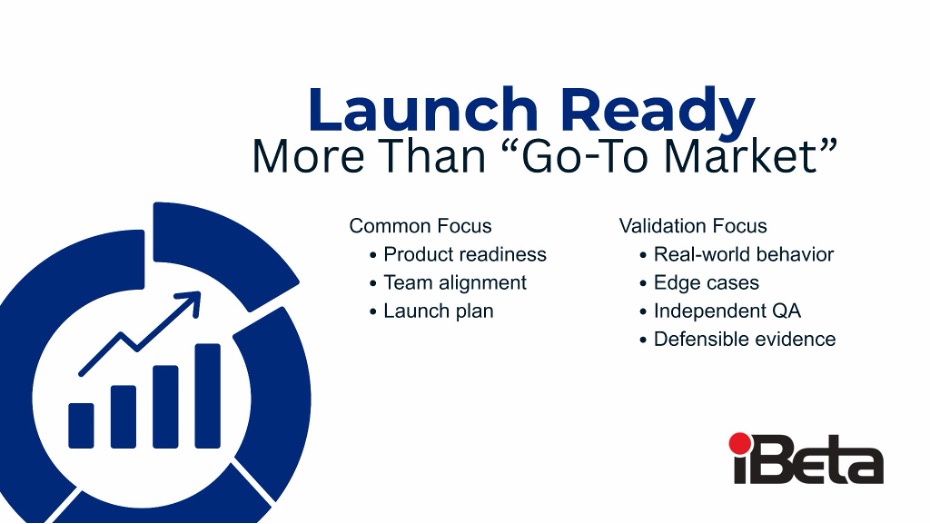
Many launch-readiness definitions focus on product completion, go-to-market alignment, marketing preparation, support training, or organizational coordination.
Those elements matter.
But they do not fully address technical readiness.
A launch can have strong messaging, stakeholder alignment, a support plan, and a polished release schedule while still failing users if the system itself has not been validated under real-world conditions.
Common launch-readiness conversations often miss:
- real-world system behavior
- edge cases
- integration failures
- environment variability
- performance under pressure
- independent validation
- documentation that supports defensible decisions
Launch-ready without validation is just optimism.
For modern software, readiness must include evidence that the system can perform beyond ideal conditions.
Why Launch-Ready Breaks Down in the Real World
Many failures happen after launch because testing did not fully reflect real-world conditions.
That does not mean teams failed to test. It means the testing environment, scenarios, or assumptions did not match reality closely enough.
Common reasons launch readiness breaks down include:
- Real users behave differently than test users.
- Scale introduces new performance issues.
- Integrations behave unpredictably under load.
- Devices, browsers, and environments vary.
- AI systems respond differently outside controlled scenarios.
- Edge cases appear only after broader use.
- Operational teams are not prepared for post-launch issues.
Software can appear stable when tested in familiar conditions. But users introduce variation.
They use different devices. They take unexpected paths. They interact with features in ways internal teams may not anticipate. They create demand at different levels and from different environments.
That is why launch readiness must be validated against real-world behavior, not just internal expectations.
Failures do not always happen because teams did not test. They often happen because testing did not match reality.
Why QA Defines Whether Software Is Truly Launch-Ready
QA plays a critical role in defining launch readiness because QA provides the evidence behind the decision.
A strong QA process helps answer:
- What was tested?
- What was not tested?
- What risk remains?
- How did the system behave under pressure?
- Were critical workflows validated?
- Did integrations perform as expected?
- Were performance limits understood?
- Is the release decision defensible?
QA does not exist to delay launch.
QA exists to define readiness.
Without structured testing, launch decisions can become subjective. Teams may rely on confidence, internal familiarity, or pressure to move forward.
With QA evidence, teams can make clearer decisions about whether the software is ready, what risks need attention, and what tradeoffs are acceptable.
That clarity matters most when timelines are tight, stakeholders need answers, or the cost of failure is high.
Internal QA vs. Independent QA in Launch Readiness
Internal QA is essential to software development.
Internal teams understand the product, the requirements, the workflows, and the context behind development decisions. They provide fast feedback, support iterative development, and help maintain quality throughout the build process.
Internal QA is especially valuable for:
- sprint-level validation
- known workflow testing
- feature verification
- regression testing
- development support
But as launch approaches, some organizations need an additional layer of validation.
Independent QA provides an outside perspective. It helps reduce blind spots created by familiarity, internal assumptions, or time pressure.
Independent QA is especially valuable for:
- objective validation
- broader environment coverage
- edge case discovery
- performance and scalability testing
- compliance documentation
- defensible launch decisions
This does not mean independent QA replaces internal QA. The strongest launch-readiness strategy often uses both.
Internal QA builds confidence throughout development. Independent QA strengthens evidence before high-stakes decisions.
Launch-ready requires both confidence and evidence.
Launch-Readiness Checklist
Before calling software launch-ready, teams should be able to answer these questions clearly:
- Have we tested under real-world conditions?
- Do we understand how the system behaves at scale?
- Are critical workflows fully validated?
- Have integrations been tested across connected systems?
- Have we tested across relevant devices, browsers, and environments?
- Do we know where risk still exists?
- Have known issues been documented and prioritized?
- Can we explain what was tested and what was not tested?
- Do we have evidence to support the release decision?
- Are monitoring, support, and rollback processes in place?
- Can we defend the launch decision if quality is questioned?
If the answer to several of these questions is unclear, the software may be close to release, but it may not be truly launch-ready.
FAQ: Launch-Ready Software
What does launch-ready mean in software?
Launch-ready software is validated to perform reliably in real-world conditions. It is not just functionally complete. It has been tested for behavior, risk, performance, integrations, and operational readiness.
Is launch-ready the same as production-ready?
Not exactly.
Production-ready often refers to whether the software can be deployed and operated in a production environment. Launch-ready is broader. It includes production readiness, but also considers user behavior, system validation, risk visibility, support readiness, and evidence for decision-making.
Can software ever be 100% ready?
No software release is completely risk-free.
Launch readiness is not about eliminating every possible issue. It is about understanding the risk, validating the areas that matter most, and making an informed decision based on evidence.
Does QA determine launch readiness?
QA plays a major role in determining launch readiness because it provides the testing evidence teams need to make informed release decisions.
QA helps clarify what was validated, where risk remains, and whether the system behaves as expected under realistic conditions.
Why do systems fail after launch?
Systems often fail after launch because real-world conditions differ from internal testing conditions.
Real users, traffic spikes, integrations, environment differences, device variability, and edge cases can expose issues that were not visible before release.
Conclusion: Launch-Ready Is a Decision, Not a Status
Launch-ready is not a feeling.
It is not a deadline.
It is not a checkbox.
It is a decision based on evidence.
Modern software launch readiness requires a clear understanding of risk, validated system behavior, and confidence that the team can support the product after release.
A system is not launch-ready simply because development is finished.
It is launch-ready when the team can explain what was tested, what risks remain, how the system behaves under real-world conditions, and why the release decision is defensible.
You do not prove readiness before launch by hoping nothing breaks.
You prove it by understanding what will happen when real users, real environments, and real pressure arrive.
If your team is preparing for a software launch, iBeta can help validate the functionality, performance, compatibility, accessibility, and risk factors that determine whether your system is truly ready.
Contact iBeta to discuss independent software testing before your next release.