
Most software teams believe performance testing is primarily about speed. It isn’t. Performance testing is about whether your users can actually rely on your system when it matters most.
Systems don’t fail when everything is normal.
They fail under pressure – during a flash sale, a marketing launch, or an unexpected traffic spike.
If your users cannot rely on your system during those critical moments, they will not rely on your brand.
For developers and product teams readying a release, performance testing is your insurance policy against a public failure.
What Is Performance Testing in Software Testing?
Performance testing is a type of software testing that evaluates how a system behaves under expected and extreme conditions. It measures speed, stability, scalability, and reliability to ensure your application performs consistently in real-world use.
Unlike functional testing, which confirms if the software works (i.e., “Does the button submit the form?”), performance testing validates how well it holds up under pressure (i.e., “What happens if 10,000 people click that button at the exact same time?”).
A system can be fully functional and still fail users entirely when subjected to load.
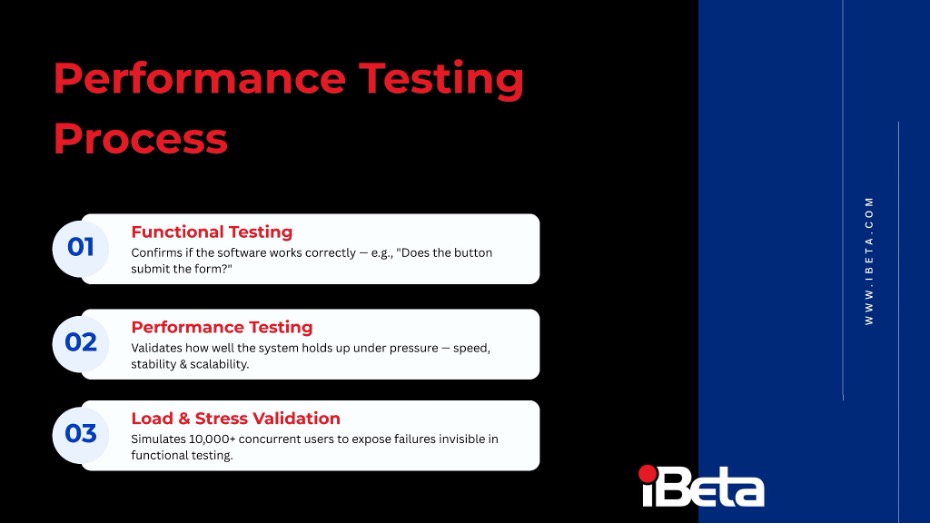
What Performance Testing Does (That Functional Testing Doesn’t)
Functional testing is essential, but it operates in a vacuum of “ideal” conditions. It ensures logic is sound. Performance testing, however, simulates the messy, unpredictable reality of production.
A system might pass every unit and integration test in your staging environment but still collapse under real-world concurrency.
Performance testing uncovers bottlenecks – like database contention, memory leaks, or inefficient resource utilization – that only manifest when the system is pushed to its limits.
It is the difference between knowing your car can start and knowing it can drive at highway speeds without the engine overheating.
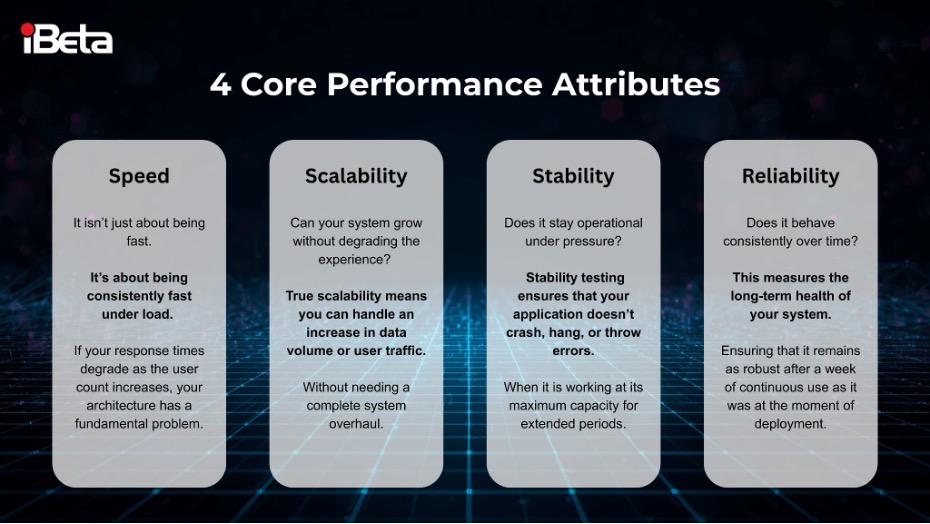
The 4 Core Performance Attributes
To build and maintain user trust, performance testing focuses on four key pillars. We measure these to determine if a system is truly ready for release:
- Speed: It isn’t just about being fast; it’s about being consistently fast under load. If your response times degrade as the user count increases, your architecture has a fundamental problem.
- Scalability: Can your system grow without degrading the experience? True scalability means you can handle an increase in data volume or user traffic without needing a complete system overhaul.
- Stability: Does it stay operational under pressure? Stability testing ensures that your application doesn’t crash, hang, or throw errors when it is working at its maximum capacity for extended periods.
- Reliability: Does it behave consistently over time? This measures the long-term health of your system, ensuring that it remains as robust after a week of continuous use as it was at the moment of deployment.
Types of Performance Testing
Not all performance testing is the same. Each method is designed to expose a different risk profile:
- Load Testing: Tests performance under expected normal usage levels. (e.g., Simulating 1,000 concurrent users browsing an e-commerce site.)
- Stress Testing: Pushes the system beyond its limits to find the breaking point. (e.g., Doubling expected traffic to see how the system handles a total resource saturation event.)
- Spike Testing: Evaluates the system’s reaction to sudden, extreme traffic bursts. (e.g., Handling a 10-minute flash sale surge.)
- Endurance Testing: Checks for memory leaks or resource degradation over a long period. (e.g., Running a streaming app for 72 hours under constant load.)
Key Performance Testing Metrics
When reviewing results, don’t just look for “pass” or “fail.” Focus on the metrics that indicate the health of your infrastructure:
- Response Time: How long the system takes to process a request. Always look at P95 and P99 percentiles, as averages often hide the bad experiences of your most “unlucky” users.
- Throughput: How many transactions or requests your system handles per second.
- Error Rate: The percentage of failed requests compared to the total. A rising error rate is usually the first sign of an impending crash.
- Latency: The delay before a system begins processing a request.
- Resource Utilization: Real-time monitoring of CPU, memory, disk, and network I/O. If your CPU is at 99% while throughput is low, you have an efficiency bottleneck.
Common Performance Testing Mistakes
Even experienced teams make avoidable errors that compromise their testing strategy:
- Testing Too Late: Waiting until the week before launch means you don’t have time to re-architect for performance. Shift your testing left.
- Testing Only Ideal Conditions: If you only test in a pristine, perfectly configured environment, you aren’t testing for the real world.
- Ignoring Edge Cases: The most critical failures often happen at the “corners” of your application – like a complex search query that only happens when a user has a massive dataset.
- Focusing Only on Speed: A system that is fast but crashes every hour is useless. Balance speed with stability.
The Hidden Cost of “Fast” Launches: Why Performance Testing Protects Your ROI
If you are facing pressure to launch immediately to satisfy investor milestones or competitive timelines, the temptation to skip performance testing is high. It feels like a shortcut to “done.”
However, launching a system without validated performance is not just a technical risk – it is a significant financial liability.

Here is how to reconcile the tension between speed and stability for your stakeholders:
- The Cost of Failure > The Cost of Testing: The cost of fixing a performance bottleneck after a failed launch—which often involves downtime, lost revenue, emergency engineering man-hours, and public damage control—can be 10x to 100x higher than the cost of preemptive testing. Frame testing as an insurance policy against your launch-day budget.
- Trust is a Currency: Investors do not just invest in features; they invest in the reliability of your system. A platform that crashes during a peak traffic event doesn’t just lose current transactions; it destroys the trust required for future growth, user retention, and enterprise-level contracts.
- “Scalability Debt” is Real: If you push to launch with unoptimized code, you are accruing “scalability debt.” Every day you delay addressing these issues, the harder and more expensive they become to untangle as your codebase grows. Testing now creates a predictable path for the scaling your investors expect.
- Validated Resilience is a Competitive Advantage: Being able to tell investors, “We have independently validated that our system holds up under 3x our expected peak load,” changes the conversation from “Are we ready?” to “How fast can we acquire customers?”
The Bottom Line for Decision-Makers: Performance testing is not a delay in your timeline; it is the de-risking mechanism that prevents your launch from becoming a liability.
We don’t just find bugs; we provide the evidence-based confidence required to scale your business without the threat of catastrophic downtime.
Performance = Trust
Performance testing isn’t about tools, scripts, or metrics. It is about reliability, user experience, and confidence under pressure.
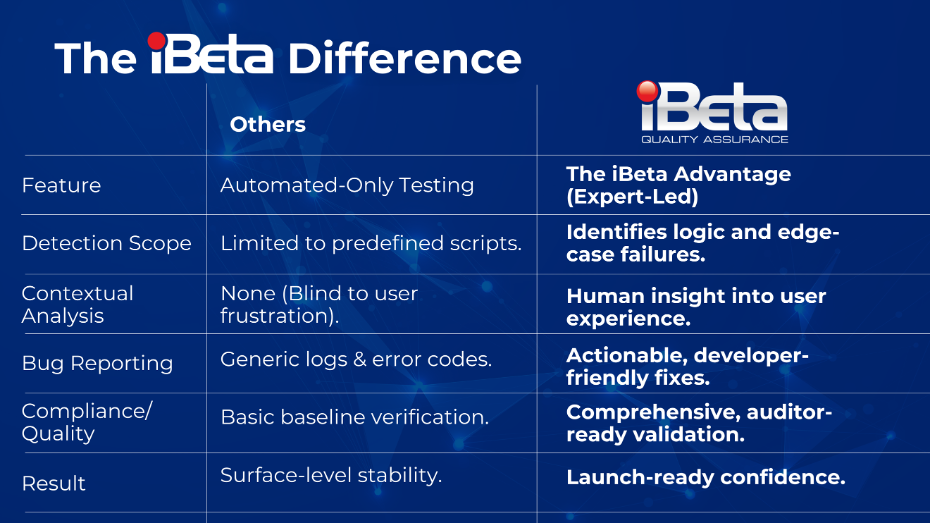
Internal testing is a great starting point, but it often lacks the independent, third-party validation required to find hidden vulnerabilities. When you have built a system, you are often blind to its weaknesses. iBeta acts as an extension of your development team, providing the manual, contextual deep-dives that automated tools simply cannot deliver.
We don’t just provide a spreadsheet of metrics; we provide the actionable intelligence you need to fix the root cause of performance bottlenecks. Whether you are dealing with critical Load & Performance testing or complex EPCS-style compliance, iBeta ensures your software is ready for the real world.
If your users can’t rely on your system when it matters, they won’t rely on your brand. Let iBeta handle the heavy lifting so you can launch with total confidence. Connect with an iBeta expert today.
Frequently Asked Questions
What is performance testing in simple terms?
It is the process of testing how your software handles traffic and stress, ensuring it doesn’t crash when it matters most.
Why is performance testing important?
It protects your revenue, reputation, and customer retention. A slow or broken site drives users to your competitors.
When should performance testing be done?
Continuously. Integrate performance testing into your CI/CD pipeline so that every major code change is validated against performance thresholds.
Can performance issues be fixed after launch?
While you can patch issues post-launch, it is exponentially more expensive and damaging to your brand than catching them during development.