Most teams test their own software. Most teams also feel confident when they’re close to release.
Then the system hits the real world.
Traffic behaves differently than expected. Integrations encounter edge cases no one saw internally. A stakeholder asks, “How do we know this is ready?” A customer reports inconsistent behavior that no one can reproduce on the team’s usual devices. And suddenly, confidence turns into uncertainty.
This is the point where many organizations start asking the same questions:
- If we’ve already done testing in-house, why invest in independent QA?
- Isn’t third-party testing duplicative?
- What does independence actually change?
- When does internal testing stop being “enough”?
This article isn’t a critique of internal QA. Internal testing is essential. But there are predictable moments where confidence breaks down, not because your team isn’t capable, but because proximity, pressure, and complexity create blind spots that independence is designed to expose.
In this article we will explore:
- What Internal Testing Does Well
- Where Internal Testing Naturally Breaks Down
- What Independent QA Actually Changes
- Is Independent QA Worth The Investment?
- When Independent QA Is Especially Important
- The Strongest Approach is Hybrid
- Where Confidence Breaks Down
- FAQ: Common Questions About Independent QA
- From Confidence to Evidence
What Internal Testing Does Well
Internal testing is a critical part of building software. When teams test in-house, they have strengths that outside partners simply don’t start with:
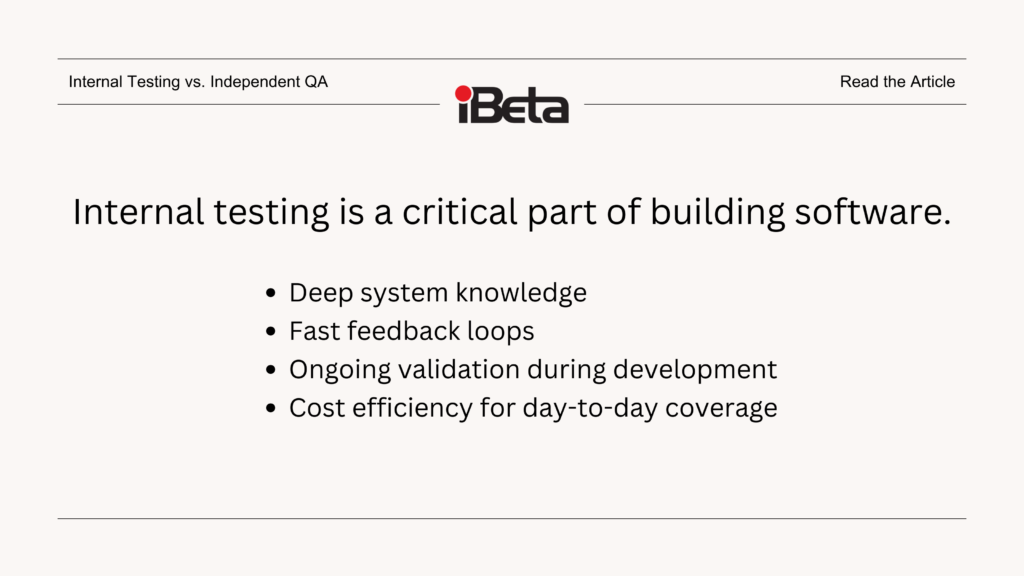
Deep system knowledge
Internal teams understand the product’s intent, architecture, constraints, and history. That context makes testing faster and more informed.
Fast feedback loops
When QA sits close to development, issues can be triaged and resolved quickly. This supports agile execution and iteration.
Ongoing validation during development
Internal testing is best positioned to validate features as they are built, ensuring quality is part of the process rather than a last-minute gate.
Cost efficiency for day-to-day coverage
Internal QA is often the most economical way to maintain baseline coverage and ensure consistency sprint to sprint. If you’re testing in-house, that’s a good thing. The question isn’t whether internal testing is valuable. The real question is, What happens when internal testing is no longer sufficient to create defensible confidence?
Where Internal Testing Naturally Breaks Down
Every internal team faces the same structural constraints. These aren’t “mistakes.” They’re the predictable side effects of being close to the product.
1) Familiarity Creates Blind Spots
The better you know a system, the more your brain fills in the gaps.
Teams tend to test what they expect users to do, because that’s what’s easiest to imagine and repeat. But real users don’t behave like the team that built the product. They bring different workflows, devices, expectations, and constraints.
That’s one of the most common places confidence breaks down: when reality doesn’t match the mental model.
2) Assumptions Get Inherited
Internal teams inherit assumptions from product decisions, stakeholder priorities, and historical tradeoffs. Over time, those assumptions become “normal,” even when they introduce risk.
Independent QA is effective because it asks questions internal teams often don’t have time, or permission, to ask:
- What are we assuming is true?
- What evidence supports that assumption?
- What happens if it’s wrong?
3) Pressure Compresses Decision-Making
Under deadline pressure, the standard for “good enough” often shifts.
This isn’t because teams stop caring. It’s because launches create competing priorities:
marketing timelines, customer commitments, revenue goals, investor expectations, and internal momentum.
When pressure rises, teams don’t just need testing, they need clarity. What was validated, what wasn’t, and what risk remains.
4) Organizational Constraints Limit Coverage
Even strong internal QA teams have limits:
- limited device/browser/OS coverage
- limited time to explore edge cases
- limited capacity to run extensive performance scenarios
- limited independence to challenge assumptions that were already “decided”
In many organizations, internal QA is expected to move fast, validate a build, and support release. That’s a different job than independent validation.
5) Exposure to Risk Patterns Is Narrower
Internal teams see one product. Independent labs see patterns across many products, industries, and failures. That broader exposure creates an advantage: independent QA can often identify risk types faster because they’ve seen the same failure modes before, just in a different system.
What Independent QA Actually Changes
Independent QA isn’t valuable because it “finds more bugs.” That’s the wrong frame.
Independent QA is valuable because it changes the nature of validation.
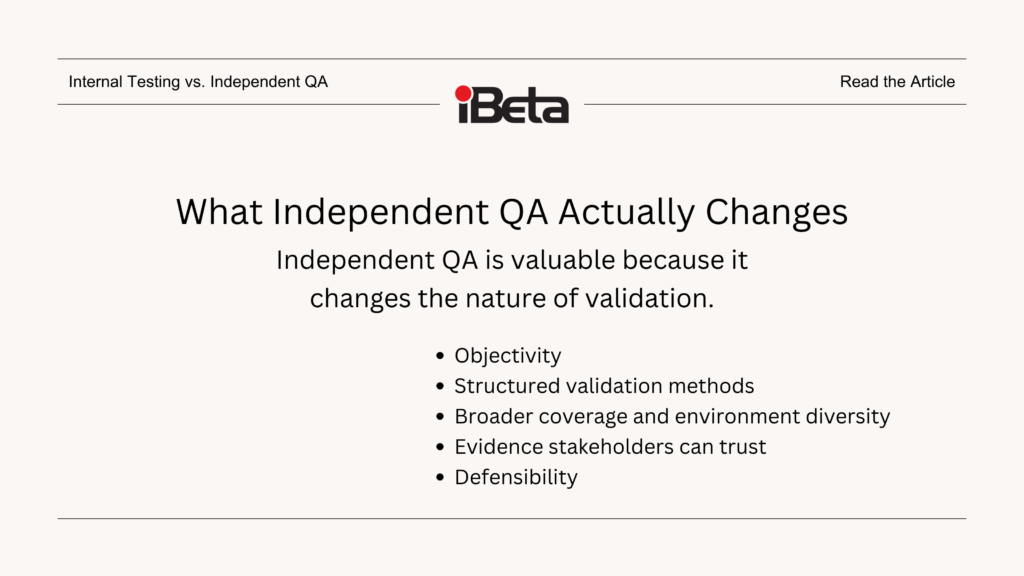
Independent QA creates:
Objectivity
Outside teams are not invested in the build decisions, timelines, or internal narratives. That distance makes it easier to see what’s actually happening and creates objectivity in testing.
Structured validation methods
Independent teams typically follow more formal testing methodologies and reporting practices. That structure matters when decisions must be defended.
Broader coverage and environment diversity
Independent labs often have access to wider device matrices, browser environments, and infrastructure for performance scenarios that internal teams may not maintain.
Evidence stakeholders can trust
For leadership, regulators, and external partners, independent validation can carry more credibility because it is not self-reported.
Defensibility
When quality is questioned, internally or externally, independent documentation provides a stronger foundation than “we tested it and it looked fine.”
Independent QA turns confidence into evidence.
Is Independent QA Worth The Investment?
This is usually the real question.
Internal testing often feels like cost control. Independent QA feels like added spend. But the more accurate framing is:
- Internal testing supports development velocity and baseline coverage.
- Independent QA supports risk control, defensibility, and stakeholder confidence.
Independent QA is rarely justified by “we found X bugs.” It’s justified by what it prevents:
- emergency rework after release
- avoidable public failures
- performance incidents during peak demand
- compliance findings during audits
- contract risk with enterprise customers
- reputational damage that outlasts the fix
The cost of independent QA is easy to measure. The cost of failure is not, until it happens.
Independent QA is most valuable when the impact of failure is high, even if the probability feels low.
When Independent QA Is Especially Important
There are situations where independent QA isn’t just “nice to have.” It’s the most responsible choice.
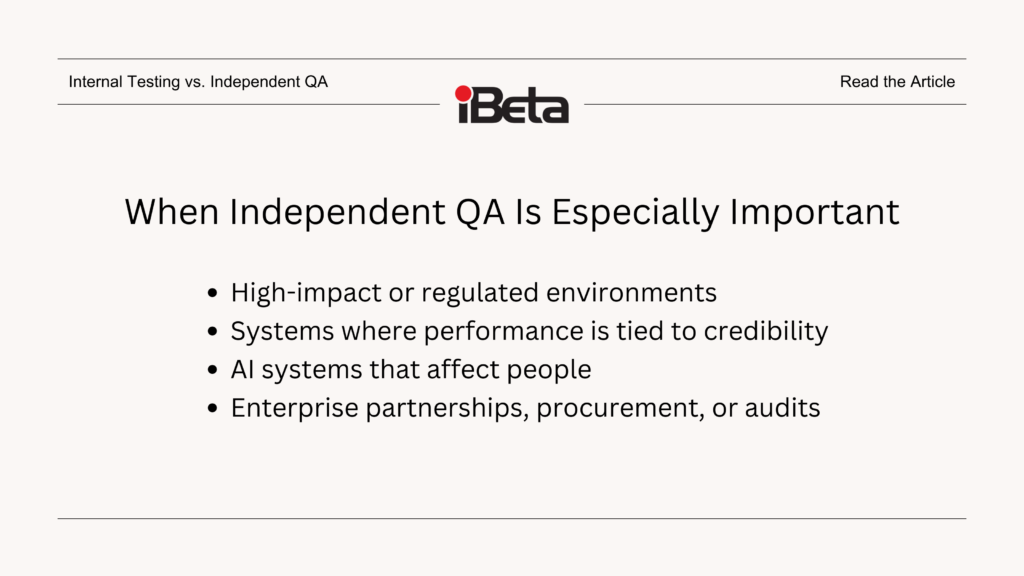
High-impact or regulated environments
- EPCS and DEA compliance
- biometrics certification and identity systems
- accessibility requirements (WCAG/Section 508)
- healthcare, finance, and other regulated industries
Systems where performance is tied to credibility
If downtime, latency, or instability would damage trust, performance and scalability validation should not rely on assumption.
AI systems that affect people
AI introduces risk beyond traditional software because systems can behave inconsistently across scenarios, inputs, and user groups. Validating behavior, not just accuracy, requires structured AI testing approaches and documentation.
Enterprise partnerships, procurement, or audits
When you must prove readiness to third parties, independent validation can become part of doing business.
The Strongest Approach is Hybrid
Independent QA is not a replacement for internal testing. The best outcomes come from combining both.
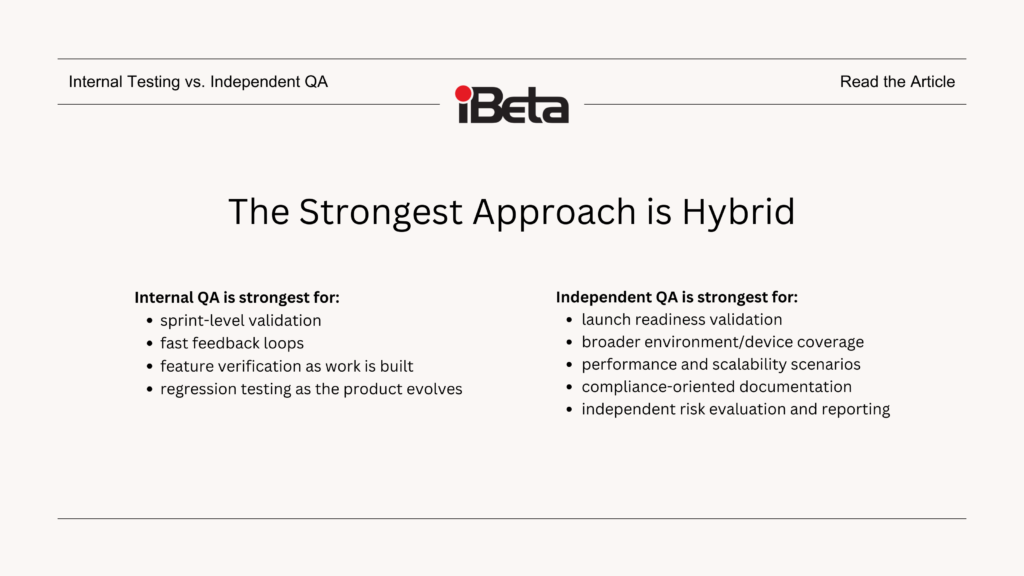
Internal QA is strongest for:
- sprint-level validation
- fast feedback loops
- feature verification as work is built
- regression testing as the product evolves
Independent QA is strongest for:
- launch readiness validation
- broader environment/device coverage
- performance and scalability scenarios
- compliance-oriented documentation
- independent risk evaluation and reporting
Hybrid QA isn’t redundancy, it’s maturity.
It’s a recognition that testing has different purposes at different stages, and the closer you get to launch, the more defensibility matters.
Where Confidence Breaks Down
Confidence breaks down at the exact moments when evidence is most needed:
- when systems scale beyond internal testing assumptions
- when real users behave differently than expected
- when integrations introduce cascading failures
- when auditors ask for proof
- when stakeholders need clarity quickly
- when AI behavior changes in the real world
Independent QA doesn’t add fear. It adds visibility.
And visibility is what allows teams to respond calmly, make better decisions, and stand behind releases when questions come.
FAQ: Common Questions About Independent QA
If we already test in-house, why bring in independent QA?
Because independence reduces blind spots. It validates assumptions, tests broader scenarios, and produces evidence that holds up under scrutiny.
Does independent QA slow development?
Not when applied intentionally. Independent QA is most effective at defined validation points, pre-launch, post-major changes, or in high-risk areas, without interrupting sprint velocity.
Is independent QA only for large enterprise companies?
No. It’s for any organization where the cost of failure outweighs the cost of validation, especially when trust, compliance, or brand credibility are at stake.
Can independent QA replace internal testing?
It shouldn’t. Internal testing is essential for ongoing quality. Independent QA complements internal teams by strengthening validation and defensibility.
How do we know when we’re ready for independent QA?
You’re ready when:
- you’re approaching a high-stakes release
- you need stronger evidence for stakeholders
- you’re entering a regulated or scrutinized environment
- your system has grown beyond simple testing coverage
- you can’t afford surprises after launch
Conclusion: From Confidence to Evidence
Internal testing builds confidence. Independent QA builds evidence.
Confidence is important, but evidence is what holds under pressure.
If your organization is making decisions where trust, compliance, or reputation matter, independent validation isn’t redundant. It’s how you turn “we think it’s ready” into “we can prove it.”
And that’s where confidence stops breaking down.
If you’re ready to get your project tested by a trusted Quality Assurance team, then it’s time to contact iBeta.